
Design Features
The Tarhu System
The tarhu family uses a unique system where an extremely light-weight wooden cone is suspended in a spherical body. The strings are connected to the cone, which functions in a similar way to a soundboard except that it is much lighter for the same area - compared to a violin soundboard, a tarhu cone is roughly the same area, roughly the same overall stiffness, but 1/10th the weight. Compared to the bowed instruments from the East that use a skin “soundboard”, a tarhu cone is a similar weight to a skin top, but has much greater stiffness. This unusual relationship between stiffness and weight gives the tarhu an unprecedented level of sensitivity and an increased breadth in tone-colour variations.
Aesthetics
One of the most striking visual features of the tarhu is the carving in the upper half of the body. This carved dome both protects the delicate cone suspended inside and provides a rigid support for the edges of the cone. The inspiration for the designs comes largely from Islamic architecture and the shell of the sea urchin.

Structure
Unlike almost all other acoustic stringed instruments, the tarhu system does not subject the sound-producing components to the destructive forces of string tension. This allows the cone to be constructed on acoustic considerations only. The neck forms a continuous structural beam right across the top of the dome, with the strings being attached to the neck at the head and behind the bridge. All longitudinal string tension is thereby taken by the neck
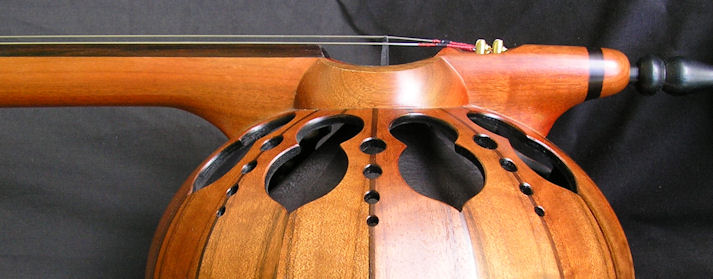
The angles formed by the strings passing over the bridge are carefully adjusted so that the downward pressure exerted by the strings on each side of the bridge is in a state of balance – the downward pressure on the cone is only just enough to prevent rattling and no more.
This structural design has other benefits; there are no glue joints in a tarhu that are under stress; any repairs necessary due to impact damage are facilitated by the fact that a tarhu can be dismantled into it’s component parts with comparative ease in minutes, require no refinishing after reassembly, and can be carried out without de-tuning the strings.
Sympathetic Strings
Having a separate set of strings that vibrate in sympathy with the main playing strings is a concept that has been used in tarhu design since the beginning. However, from very early on in the tarhu’s development there have also been tarhus that did not use sympathetic strings. The choice to use sympathetics is dependent to an extent on the type of music being played - but more importantly it is dependent on the player’s individual preferences. There are those who could not imagine playing a tarhu that didn’t have the extra resonance that can make one feel as if one is playing in a cathedral - even in the deadest room. Conversely there are those who find that the sympathetic resonance just gets in the way.
The Shahkaman and the kamancheh tarhu are a useful pair of instruments to examine in this regard - the techniques used on these two tarhus are virtually identical and the acoustic design is likewise identical. The two instruments behave in very different ways, however. This is partly because of what the sympathetic resonance contributes to the shahkaman’s sound, but also because of the extra restrictions that the tension of the sympathetic strings places on the bridge. The tarhu acoustic design relies heavily on using super light-weight components in the cone and bridge. One consequence of this fineness is that the total amount of string tension passing through the bridge has a significant bearing on how the bridge vibrates, and as a result of that, on what vibrations are then transferred to the cone. If one pictures a 5 string shahkaman with 7 sympathetic strings, the total amount of string tension that the bow encounters when it tries to set the bridge in motion is quite large when compared to the resistance encountered by the bow when playing a 4 string kamancheh tarhu. This difference manifests in a significantly broader range of tone colours being available on a kamancheh tarhu when compared to a shahkaman constructed in an otherwise identical fashion.
For these reasons, a player who is mostly interested in the world of tone colour variations is better off choosing a kamancheh tarhu, and a player who is more interested in the surround-sound of the sympathetic-string world is better to choose a shahkaman. These same principals apply to an even greater extent in relation to the choice between a nak tarhu and a 3 string lyra tarhu. The nak tarhu has 5 playing strings and 12 sympathetic strings and consequently the resistance experienced by the bow is quite significant when compared to a 3 string lyra tarhu without sympathetic strings.
Bridge Design
The design of the bridge greatly affects the final sound of a tarhu. The bridge has two feet: one is active, and is connected directly to the cone; the other is passive, resting on the neck of the instrument where it passes over the body. The passive foot acts as a pivot in a similar way to a soundpost in the violin family.

The way in which the bridge affects the sound of the instrument is determined by many inter-related factors.
Some of these are:
The weight and stiffness of the bridge;
The distance between the bridge feet;
The location of the passive foot;
the height and width of the bridge in relation to the location of the passive foot;
The amount of downward pressure exerted on the bridge and how this pressure is distributed;
the total amount of string tension
The passive foot of the bridge is adjustable in two ways:
1. The bridge rests on a piece of spring-steel wire that can be moved either towards the edge or the middle of the bridge, changing the location of the pivot point
2. The effective length of the spring-steel wire can be changed by moving the supports on each end of the wire in or out, changing the degree of flexibility at the pivot point. Such changes correspond to the fine adjustments made to the position of the soundpost in violin making.

The adjustable bridge pin allows each musician a significant amount of personalised tonal adjustment.